


Drone Spraying In Agriculture - What Farmers Should Know Before Using Drones For Pesticide Application.
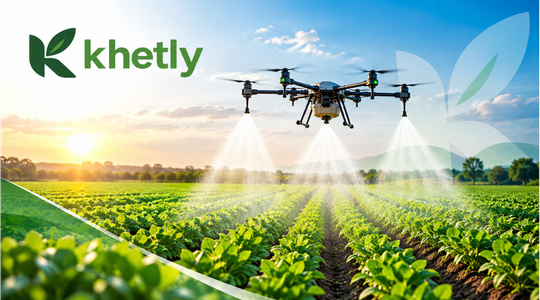
Drone Spraying in Agriculture, What Farmers Should Know Before Using Drones for Pesticide Application.
Drone spraying in agriculture is becoming increasingly popular in India. Agricultural drones can help farmers complete spraying operations faster, reduce labour requirements and improve the precision of input application.
However, drone spraying should not be viewed as a shortcut to higher crop production. The technology can improve the application process, but crop yield still depends on several factors including crop variety, soil health, nutrition, irrigation, weather conditions and effective pest and disease management.
Does Drone Spraying Automatically Increase Crop Yield?
One of the common misconceptions about agricultural drones is that spraying pesticides through a drone automatically increases crop yield.
This is not correct.
A drone is primarily an application and precision agriculture tool. It can help apply inputs efficiently and at the right time, but the drone itself does not guarantee higher production.
For example, if a crop does not have a significant pest or disease problem, simply spraying a pesticide using a drone will not necessarily increase yield.
Yield improvement depends on whether the right crop management decision has been taken in the first place.
ICAR's work on drone-based crop management has demonstrated benefits such as improved precision, application efficiency and reduced water requirements in specific crop and application conditions.
Can Every Pesticide Be Sprayed Through a Drone?
No.
This is one of the most important points farmers should understand.
Not every pesticide or agricultural input should automatically be transferred from a conventional sprayer to a drone.
Before drone application, farmers and service providers should check whether the particular product and application method are approved/recommended for that use, along with the appropriate dose and application protocol.
ICAR-NRCIPM's pesticide tools provide information on label claims, recommended dosages, methods of application and application technology for different crops and target pests and diseases.
ICAR institutes are also developing crop- and formulation-specific Standard Operating Procedures for drone applications, including parameters such as dosage, efficacy, spray drift and particle size.
Therefore, farmers should not assume that a pesticide suitable for conventional spraying is automatically suitable for drone spraying.
Why Is the Label and Recommended Dose Important?
The pesticide label and authorised recommendation are important sources of information for deciding how a product should be used.
Farmers should check:
- Whether the product is recommended for the particular crop
- Whether it is recommended for the target pest or disease
- The recommended dose
- The recommended application method
- Water volume or spray concentration where specified
- Any specific precautions or restrictions
Do not increase or reduce the pesticide dose simply because a drone is being used.
The correct application protocol should be followed according to the product's authorised recommendation and the relevant technical guidance.
Is Drone Spraying Suitable for Every Crop?
Not necessarily.
Drone spraying can be useful in several crops and situations, but its effectiveness depends on factors such as:
- Crop height
- Crop canopy
- Leaf arrangement
- Target pest or disease
- Location of the pest within the canopy
- Pesticide formulation
- Droplet size
- Spray coverage
- Weather conditions
- Drone operating height and speed
ICAR has conducted drone demonstrations across different crops, including potato, rice, maize, chilli, coconut, brinjal, mango, sugarcane and other crops. This shows the potential of the technology, but it does not mean that the same drone settings or pesticide application protocol can be applied universally to every crop.
Does Less Water Mean Better Spraying?
Drone spraying often uses a lower spray volume than conventional spraying.
However, lower water volume does not automatically mean better results.
The objective should be adequate and uniform coverage of the target area while maintaining the required application rate.
Factors such as droplet size, spray pattern, crop canopy, operating height, speed and weather conditions can affect the final spray coverage.
For example, ICAR's potato research evaluated drone spraying for uniformity, penetration, drift and phytotoxicity rather than simply assuming that lower water volume would produce better results.
Weather Conditions Matter
Weather conditions can significantly influence spray application.
Before spraying, operators should consider:
- Wind speed and direction
- Temperature
- Relative humidity
- Possibility of rainfall
- Spray drift conditions
Strong winds can increase the possibility of spray drift, potentially moving the spray away from the intended target.
Therefore, drone spraying should be carried out under suitable weather conditions and according to the relevant application guidelines.
Drone Spraying Can Reduce Labour and Time
One of the important advantages of agricultural drones is operational efficiency.
Drone spraying can help cover agricultural fields quickly and can reduce the physical exposure of workers to pesticides during spraying.
ICAR demonstrations have reported improved work efficiency and reduced direct exposure to agrochemicals in suitable crop situations.
However, faster spraying should not mean less attention to application quality.
The objective should be:
Correct application + proper coverage + appropriate timing.
Drone Is a Tool, Not a Replacement for Agronomic Decision-Making
Before deciding to spray, the first question should not be:
“Can I spray this using a drone?”
The first question should be:
“Does my crop actually need this treatment?”
A practical decision-making sequence is:
Crop → Problem → Target Pest/Disease → Recommended Product → Correct Dose → Appropriate Application Method → Suitable Weather → Proper Application
This approach helps ensure that technology is used where it provides genuine value.
What Farmers Should Check Before Drone Spraying
Before arranging a drone spray operation, farmers should consider the following checklist:
1. Identify the problem
Confirm whether the crop actually has a pest, disease, weed or nutrient-management requirement.
2. Select the right product
Use only a product appropriate for the crop and target problem.
3. Check the authorised recommendation
Verify the recommended dose and application method for the intended use.
4. Confirm drone suitability
Do not assume that every product can be applied through a drone.
5. Check weather conditions
Avoid unsuitable conditions that can cause poor coverage or spray drift.
6. Ensure proper calibration
Drone speed, flight height, nozzle configuration, droplet characteristics and spray volume should be appropriately calibrated.
7. Maintain safety
Operators should follow appropriate pesticide-handling and drone-operation safety procedures.
The Future of Drone Technology in Indian Agriculture
Agricultural drones have significant potential in India's farming sector.
ICAR institutions are actively conducting demonstrations and research on drone-based crop protection, precision application and development of standard operating procedures.
The future is not simply about spraying more fields with drones.
The bigger opportunity is to use drones for more precise, timely and resource-efficient farm operations.
As research and crop-specific protocols develop, drone technology can become an increasingly useful part of precision agriculture.
Khetly's Recommendation
Drone spraying should be based on agronomic need—not simply because a drone is available.
A drone can make application faster and more efficient, but it does not replace proper crop management.
Remember:
Right Crop + Right Problem + Right Product + Right Dose + Right Time + Right Application Method = Responsible Crop Protection
A drone is a tool for better application not a guarantee of higher yield.
Source - Indian Council of Agricultural Research (ICAR)